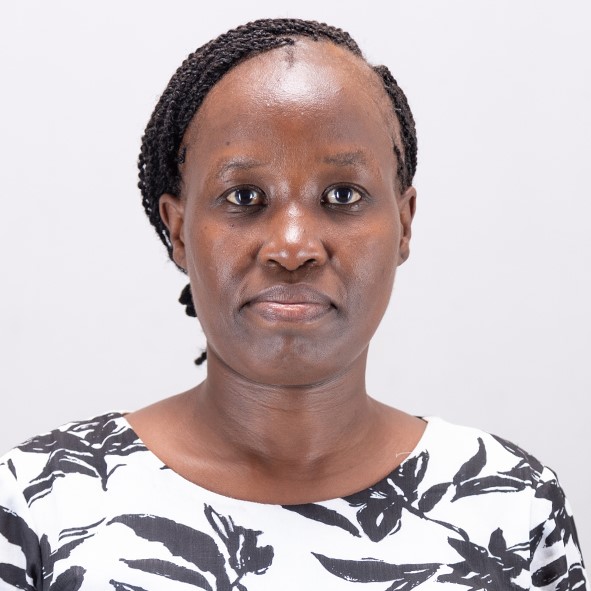
Senior Research Scientist Mariculture Artemia & Sustainable Aquaculture Live Feeds • Mariculture • GIS • Remote Sensing • Blue Economy Location KMFRI Mombasa Years of Experience 2009–Present (17 Years at KMFRI) Department Mariculture Research Interests Artemia pond culture; GIS and Remote Sensing; Fish breeding; Fish feed production (live and formulated feeds); Marine hatchery development and operations; Blue economy and coastal livelihoods; Environmental management in aquaculture | Research Focus: Advancing sustainable mariculture and aquaculture systems through Artemia production, live feed technologies, and GIS-based environmental management to support food security, nutrition, and resilient coastal livelihoods in East Africa. Morine Mukami Ngarari is a Senior Mariculture Research Scientist at the Kenya Marine and Fisheries Research Institute (KMFRI) with over fifteen years' experience in advancing sustainable fisheries and aquaculture systems to support food security, nutrition and resilient coastal livelihoods in East Africa. She currently leads the Artemia research team within the KMFRI Mariculture Division, providing scientific and technical leadership in the development of environmentally responsible mariculture production systems. She holds a Bachelor of Science in Fisheries and a Master of Science in Environmental Information Systems from Moi University and is currently pursuing a PhD in Environmental Studies at Karatina University, Kenya. Her expertise spans sustainable aquaculture and mariculture development, Artemia production and utilization, environmental management, GIS and remote sensing, marine spatial planning and aquaculture value chain strengthening, with a strong focus on nutrition-sensitive and climate-resilient food systems. Morine has served as a Principal Investigator, Co-Investigator, Deputy Lead and Project Coordinator in numerous nationally and internationally funded initiatives supported by NORAD, WIOMSA, IDRC, the European Union, NRF, VLIR and BMEL. These projects have addressed sustainable seaweed farming, marine hatchery establishment, finfish and shellfish culture, value addition and inclusive blue livelihood diversification, particularly among smallholder farmers, youth and women in coastal communities. Currently, Morine is engaged by Future Fish in collaboration with the World Bank as the East Africa Artemia Specialist, where she is contributing to the development of technical documents on Artemia production to inform investment decisions and promote sustainable aquaculture growth for improved food and nutrition security. She has published widely in peer-reviewed journals, technical manuals and policy briefs and actively participates in regional and global scientific forums. Morine is committed to translating science into policy-relevant and practical solutions that strengthen sustainable fisheries and aquaculture systems for food security and nutrition outcomes. Research & Administrative Responsibility
Research Interest / Areas of Expertise
Academic Qualifications
Professional Membership
Professional Services
Awards and Honours
Selected Publications Munguti, J., Muthoka, M., Kyule, D., Nzioka, A., Ogello, E., Magondu, E. W., Mukami, M., & Wainaina, M. (2025). Current Status and Production Trends of Commercially Cultured Mariculture Species Along the Kenyan Coast: Challenges, Opportunities and Future Prospects. Aquaculture, Fish and Fisheries, 5(5). https://doi.org/10.1002/aff2.70118 Ngarari, M. M., Hinzano, S. M., Opiyo, M. A., Rugendo, D. G., Midumbi, D. O., Okalo, F. A. et al. (2024). Salinity tolerance, growth and survival of three Artemia franciscana (Kellogg, 1906) populations under laboratory conditions. Aquaculture, Fish and Fisheries, 4, e166. https://doi.org/10.1002/aff2.166 Hinzano, S. M., Ngarari, M. M., Opiyo, M., Okalo, F., Mindraa, B. N., Midumbi, D., & Gitari, D. (2023). Effects of feeding different densities of Artemia nauplii on the growth and survival of larvae of the hairy river prawn, Macrobrachium rude (Heller, 1862). Ege Journal of Fisheries and Aquatic Sciences, 40(4), 259-265. https://doi.org/10.12714/egejfas.40.4.04 Ngarari, M. M., and Nzioka, A. (2023). Environmental considerations for habitat conversion for aquaculture. In J. Uku, A. Allela, M. Osore and N. Wambiji. (Eds.), Marine Spatial Planning and the Blue Economy in Kenya. Paris, Nairobi. UNESCO. (IOC Technical Series, 177). Hinzano, S. M., Okalo, F. A., Ngarari, M. M., Opiyo, M. A., Ogello, E. O., Fulanda, A. M., Odiwour, D. O., and Nyonje, B. M. (2022). Phytoplankton distribution along a salinity gradient in two Kenyan saltworks (Tana and Kurawa). WIO Journal of Marine Science 21 (1) 2022 113-124. 10.4314/wiojms.v21i1.9 Mwaluma, J., Mirera, D., Nyonje, B. and Ngarari, M. M. (2021). Aquaculture investments and opportunities for coastal counties. Chapter 7: p. 245-264 In: From Ridge to reef: A Legacy for sustainable coastal development in Kenya. (Eds) Ruwa, R. Uku, J. Osore, M. and Mwangi, S. Kenya Marine and Fisheries Research Institute, Mombasa. (2021), xiv+ 412p. Mirera, D.O., Kimathi, A., Ngarari, M. M., Magondu, E. W., Wainaina, M and Ototo, A. (2020). Societal and environmental impacts of seaweed farming in relation to rural development: The case of Kibuyuni village, south coast, Kenya. Ocean and Coastal Management 194. World Bank Scaling Artemia Aquaculture Documents: (a) Scaling Artemia Aquaculture: Emerging Markets and Trade: Report number 213149 – https://documents.worldbank.org/en/publication/documents-reports/documentdetail/099073026144527656 (b) Scaling Artemia Aquaculture: Synthesis of Global Opportunities: Report number 213151 – https://documents.worldbank.org/en/publication/documents-reports/documentdetail/099073026144534468 (c) Scaling Artemia Aquaculture for Feed and Food Across Geographies: Report number 213152 – https://documents.worldbank.org/en/publication/documents-reports/documentdetail/099073026144514760 Links |